
Bachelors of Science & Minor in Data Science
Our Bachelors of Science (BS) in Data Science is both a strong standalone major and designed to pair well with a second major; the Minor adds data science capability to any primary field. You do not need prior statistics or advanced math coming in - we teach the quantitative foundations as part of the program.
What You'll Gain
You’ll gain the ability to turn messy, real-world data into clear, defensible insights using modern computing, machine learning, and responsible AI. You’ll learn how to frame questions, build and evaluate models, and communicate results to technical and non-technical audiences. In the BS, you build a substantial portfolio through advanced coursework and sustained project work that you can use for internships, jobs, and graduate programs. In the Minor, you develop a practical, transferable toolkit you can apply immediately in your primary major and career path.
Compare Undergraduate Pathways in Data Science
Major in Data Science (BS) |
Minor in Data Science |
|
|---|---|---|
|
|
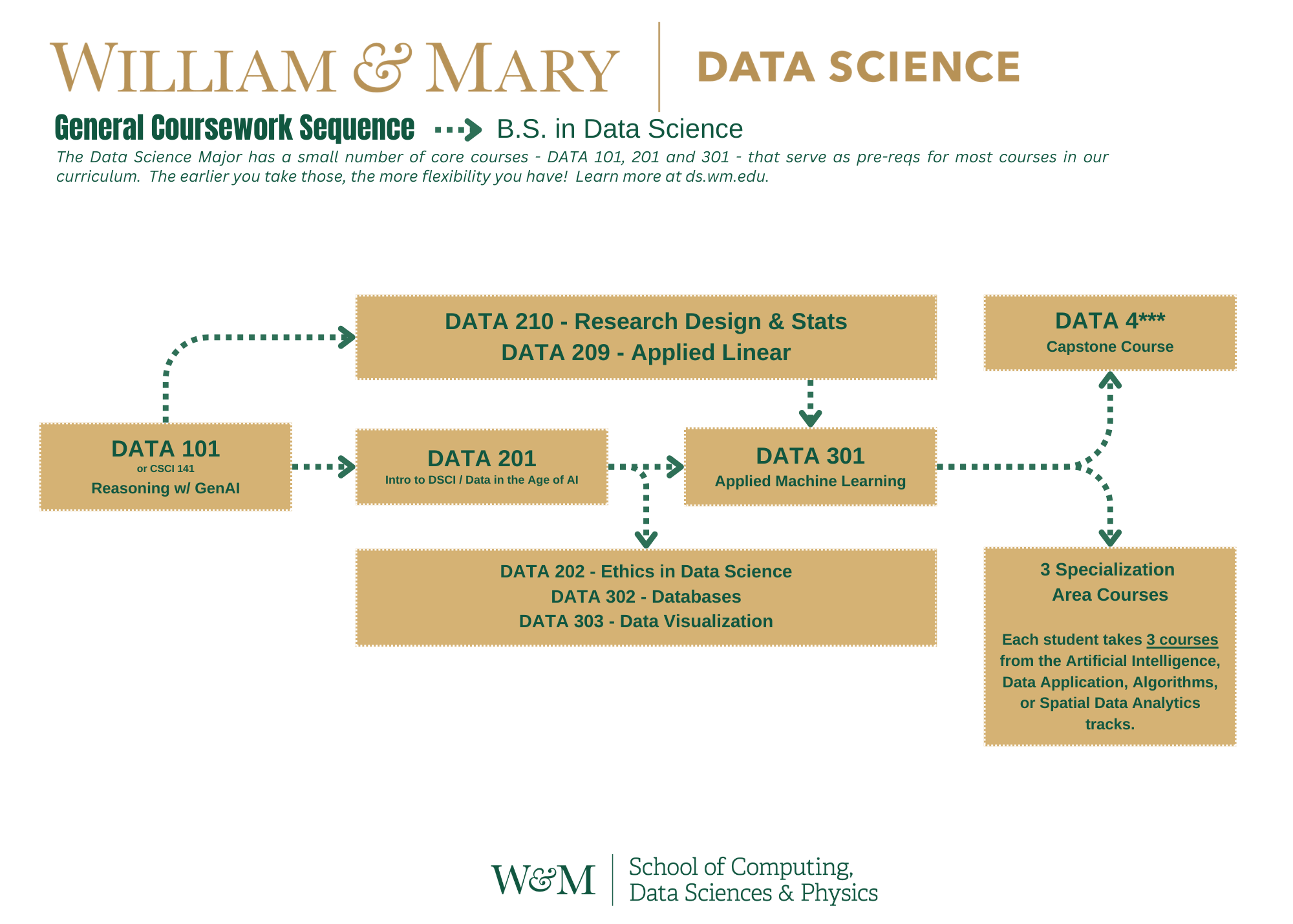
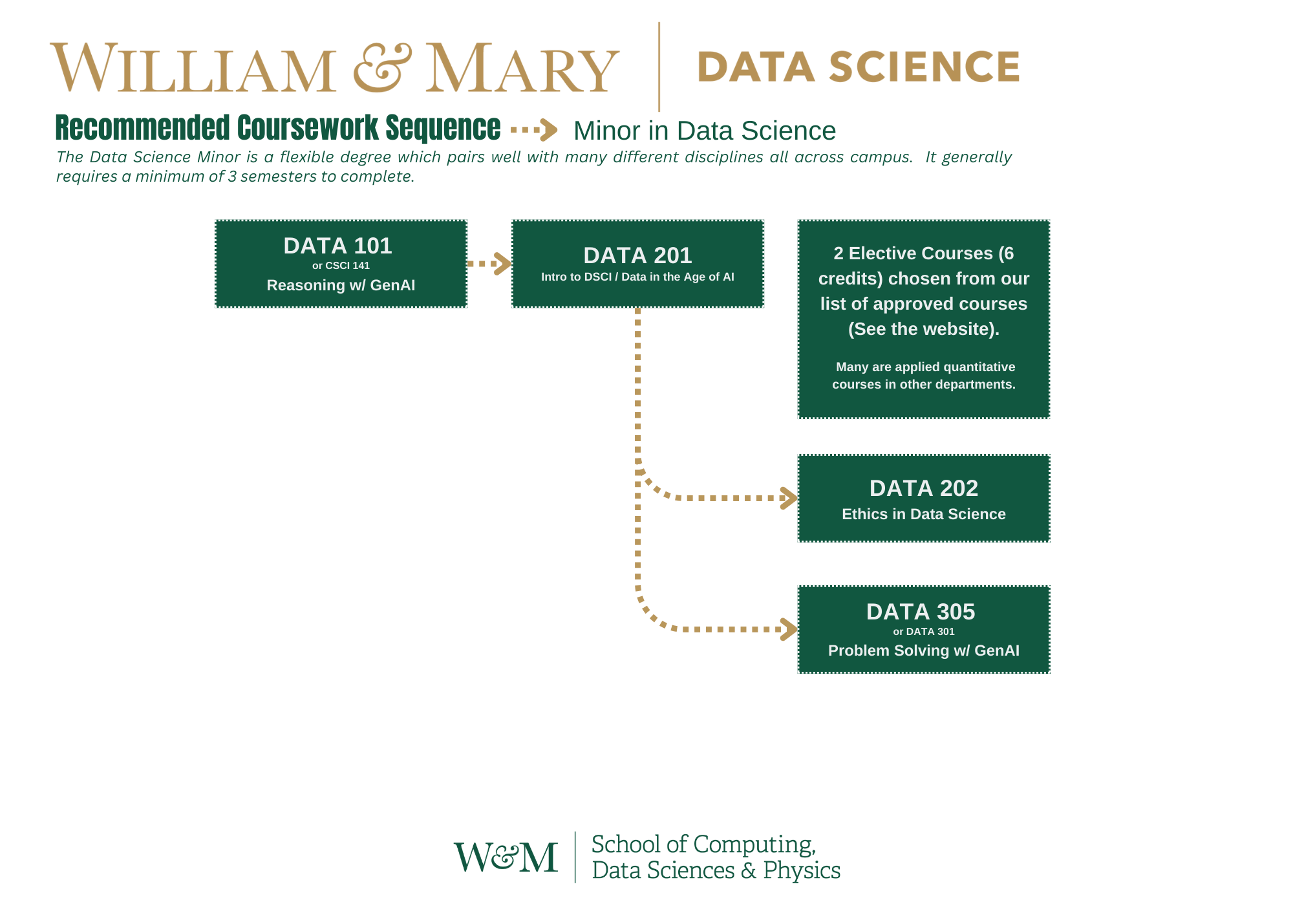
Example BS Schedule | Example Minor Schedule |
Who It's For |
For students who want deep training in data science and to graduate highly competitive for internships, jobs, and graduate programs - whether as a standalone major or with a double major. | For students who want to add practical data science skills to another major without taking on a second full degree. |
How Long it Takes |
A full-time 36-credit program designed to be completed in four to five semesters. | An 18-credit hour minor with the option to count six credit hours of quantitative coursework taken in other units. |
Background |
No prior statistics or advanced math is expected. We start from fundamentals and build the computing and quantitative depth needed for upper-level data science work. | No prior statistics or advanced math is expected. The minor is structured to fit alongside other majors and provides the core foundations needed to use data science in your primary field. |
Specializations |
Choose one track - Artificial Intelligence, Data Applications, Algorithms, or Spatial Data Analytics. | No track required; choose electives that apply data science in your major or interests. |
|
|
Frequently Asked Questions
What background do I need to succeed in the undergraduate Data Science programs?
You do not need prior coursework in statistics or advanced math to start. The program is built to teach the quantitative foundations and computing skills you need as you go, with support and on-ramps for students coming from a wide range of academic backgrounds.
When should I start taking Data Science coursework?
Students enter into our program at all stages - ranging from seniors declaring the minor to Sophomores starting our major program. Most students start coursework between Sophomore and Junior year. You can see our visual guide to the major and minor to help you plan your studies.
Do I need to apply separately to the major or minor if I am a student in Arts & Sciences?
No. Students do not need to apply separately to the School of Computing, Data Sciences & Physics if they are already students in Arts & Sciences at William & Mary. You can directly declare the major or minor in the same way as any other A&S major.
What do my course fees support?
Course fees support hands-on computing resources, including access to high-performance computing, Raspberry Pi kits and other hardware, and the maintenance and expansion of our ISC4 facilities and computational labs, along with core instructional software and lab infrastructure.
Who should I reach out to with questions?
The best way to ask a question is to email datascience@wm.edu, which is monitored by multiple staff and faculty and should get you the quickest response.
Do you accept transfer or AP credit, and how is it applied? Can courses be exchanged for similar courses in other departments?
In some cases, it may be possible for you to receive credit from other sources (another department, transfer from another university, or AP credits) that could take the place of courses in the DATA curriculum. To request such a consideration, please email the details (including the syllabus of the course you took and what you would like to substitute it for) to datascience@wm.edu . It will then be assessed and, if necessary, voted on by our curriculum committee.
I would like to take DATA 490 with a faculty member in another department. Is that possible?
Yes, but the faculty member must submit a short proposal (no more than one page) to our Data Science Curriculum Committee. Proposals should be sent to datascience@wm.edu, and have the words "Affiliate Proposal for DATA 490" in the title. The proposal should address the following:
- What is the goal of the independent study?
- A description of the data that will be used.
- A description of the proposed methods/techniques that will be used.
- The desired number of credits (3 or 4).
The committee will review the proposal and, if accepted, will initiate the process of creating a new section of DATA 490.
What are the guidelines for transferring study abroad credits?
- Any course that a student wishes to apply to their Data Science major must receive pre-approval from the Data Science department. Whenever possible, students should contact the foreign institution to obtain course syllabi for review before making their request. If a syllabus is not available, then a description of the course in as much detail as possible should be provided. Each department at W&M has a designated faculty approver. The current faculty approver for Data Science can be found here: https://www.wm.edu/offices/revescenter/geo/studyabroad/coursecredit/.
- The core Data Science requirements below should be taken at W&M, including DATA 201 Intro to Data Science, DATA 202 Ethics in Data Science, DATA 301 Applied Machine Learning, DATA 302 Databases, and DATA 303 Data Visualization. Exceptions may rarely apply, but require the consent of the Data Science Curriculum Committee.
- The Capstone requirement must be satisfied at W&M.
- For all other courses, if they are nearly equivalent to a W&M Data Science course, then they may be transferred under the corresponding W&M course number. This will be approved by the faculty approver after consulting with faculty who are familiar with teaching the course. If a course has no W&M equivalent but covers relevant Data Science topics, then it may be transferred as a DATA 340 (Special Topics). These requests will be approved by the faculty approver after consulting with the Data Science Curriculum Committee.
Can I double major?
Yes - a large portion of Data Science students have a secondary major in another field.
Do students with a declared major or minor receive any advantages in course enrollments?
Yes - if you intend to graduate with a major or minor degree in Data Science, it is prudent to declare as early as possible, as some courses may become major or minor-locked under some circumstances (especially at the DATA 300+ level).
What type of readings are involved in first-and-second-year courses? (e.g. articles, textbook) How much reading should a student expect to do per week?
The readings for first-and-second-year courses in the Data Science department at William & Mary are carefully curated to provide both foundational knowledge and exposure to current research. Students can expect a combination of textbooks, journal articles, and relevant technical documentation. The department emphasizes a hands-on learning approach, so readings often complement practical assignments. On average, students should expect around 30–50 pages of reading per week, depending on the course, with more emphasis on application than extensive reading loads.
What sorts of assignments should a student expect in first-and-second-year courses? (e.g. quizzes, group projects, presentations)
Students can expect a variety of assignments designed to build both theoretical understanding and practical skills. Common assignments include coding projects that involve real-world data analysis, problem sets to reinforce key concepts in statistics and machine learning, and individual or group-based projects that culminate in reports or presentations. There are also regular quizzes to assess foundational knowledge and provide feedback on progress. Many courses emphasize collaborative work, so students should be prepared for group projects that mimic real-world data science challenges.
Beyond the required course texts, are there other course materials a student should be prepared to purchase for first-and-second-year courses?
Students generally do not need to purchase additional materials beyond what is provided through the course. Many resources, such as academic papers, datasets, and software tools, are made available through the course platform or are open source. For students with limited computing power, the department provides access to powerful resources like the SciClone Jupyter Notebook environment (https://notebooks.sciclone.wm.edu/), which enables cloud-based data analysis and coding. This resource ensures all students have the necessary computing power for coursework.