
Major in Applied AI
Our major in Applied AI (B.A. in Interdisciplinary Studies) is built for the world you’re walking into: one where generative AI is rapidly reshaping how work gets done in nearly every industry. In a lot of careers, the baseline expectation is shifting from “Can you do this task?” to “Can you do this task well while directing AI tools responsibly?” This major is for students who want to be on the leading edge of that shift - learning how to use modern AI to produce higher-quality work, faster, in real organizations. It’s designed to pair naturally with almost any major and focuses on how to solve real problems with AI - how to choose the right tools, direct them effectively, and evaluate results - rather than on writing the underlying code.
What You'll Gain
You’ll build the critical and computational thinking skills to take messy, open-ended problems and turn them into clear, solvable tasks. You’ll learn how to choose the right AI tools, design reliable workflows, and evaluate outputs with a skeptical, evidence-based mindset - from research and writing to analysis, planning, and decision support. You’ll practice directing AI systems the way you’d manage a team: setting goals, coordinating multiple tools/agents, checking quality, and communicating results clearly to stakeholders. You’ll graduate with a portfolio of real deliverables that demonstrates you can apply AI responsibly and effectively in professional settings across careers and disciplines.
Undergraduate Pathway in Applied AI
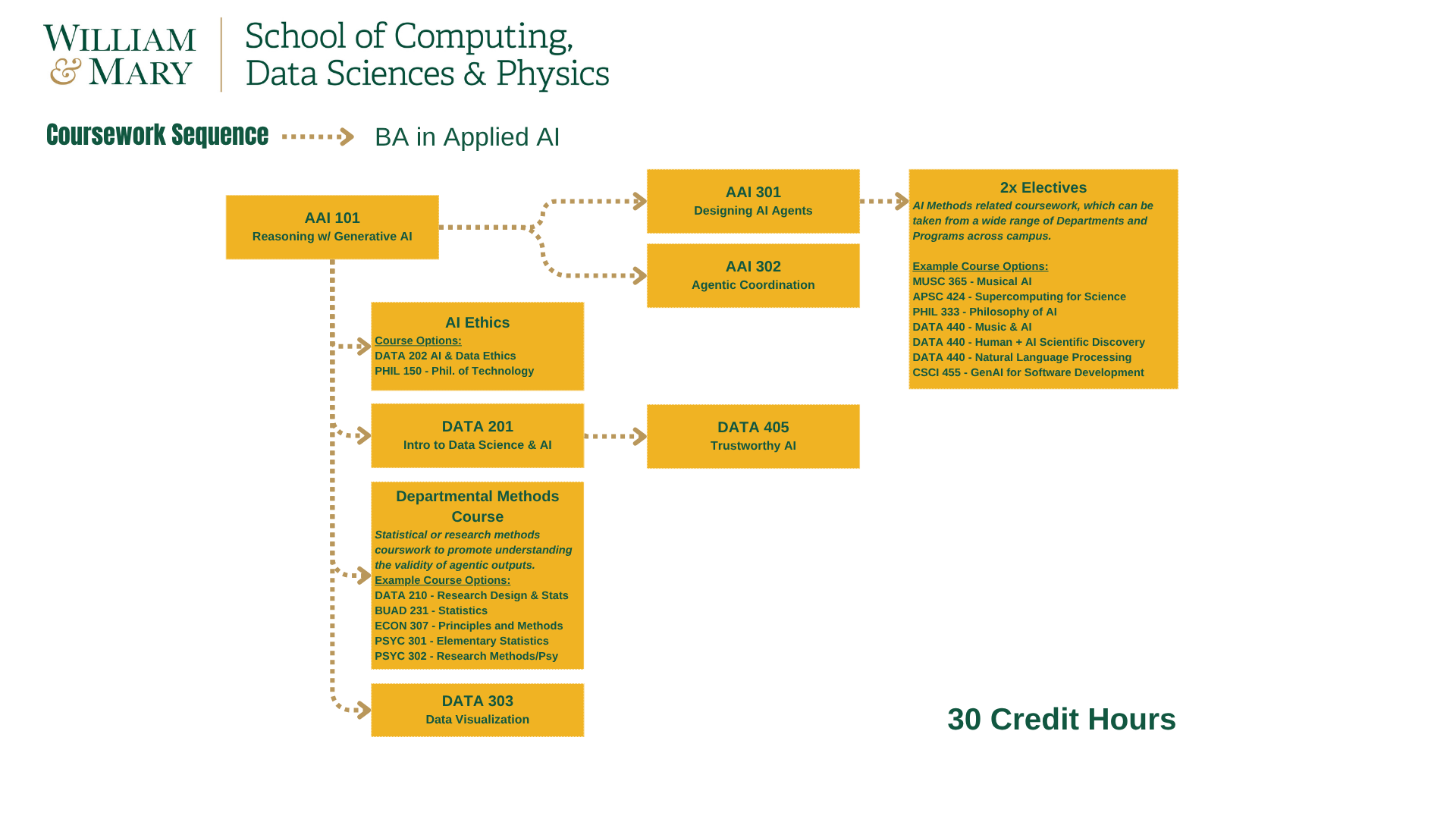
Major in Applied Artificial Intelligence |
|
|---|---|
|
|
Example Pathway |
Who It's For |
For students who want to graduate workforce-ready with the ability to use AI to solve real problems - highly competitive for internships and jobs across industries - whether as a standalone major or paired with a second major. |
How Long it Takes |
A full-time 30-credit undergraduate major is designed to be completed in four to five semesters. Students will earn a BA in Interdisciplinary Studies with a Major in Applied Artificial Intelligence. |
Background |
No prior coding, statistics, or advanced math is expected. We start from fundamentals and build the technical and analytical skills you’ll need to apply AI effectively in upper-level work. |
Specializations |
You can tailor the major through AI-relevent electives from Departments all across the university. In many cases, those courses can also count toward a second major, letting you build AI expertise directly alongside another field. |
|
|
Frequently Asked Questions
What background do I need to succeed in the major in Applied AI?
The major in Applied AI is built around the responsible, effective use of AI ("AI Slop" is a failing grade here!). We designed the major to give you a strong foundation from the ground up. You will learn how to program with AI, analyze data with AI, and create high-quality reports and real-world deliverables using these tools ethically and transparently. If you want hands-on experience with AI, guided by faculty who study, teach, and build with these technologies, this major is an excellent fit.
When should I start taking coursework?
Students enter into our majors at all stages - ranging from seniors declaring the minor to Juniors starting our major program. Most students start coursework between Sophomore and Junior year.
Do I need to apply separately to your majors if I am a student in Arts & Sciences?
No. Students to not need to apply separately to the School of Computing, Data Sciences & Physics if they are already students in Arts & Sciences at William & Mary. You can directly declare the Data Science major, Data Science minor, or Applied AI major in the same way as any other A&S major.
What do my course fees support?
Course fees support hands-on computing resources, including access to high-performance computing, Raspberry Pi kits and other hardware, and the maintenance and expansion of our ISC4 facilities and computational labs, along with core instructional software and lab infrastructure.
Who should I reach out to with questions?
The best way to ask a question is to email datascience@wm.edu, which is monitored by multiple staff and faculty and should get you the quickest response.
Do you accept transfer or AP credit, and how is it applied? Can courses be exchanged for similar courses in other departments?
In some cases, it may be possible for you to receive credit from other sources (another department, transfer from another university, or AP credits) that could take the place of courses in the curriculum. To request such a consideration, please email the details (including the syllabus of the course you took and what you would like to substitute it for) to datascience@wm.edu . It will then be assessed and, if necessary, voted on by our curriculum committee.
I would like to take independent research (DATA 490) with a faculty member in another department and have it count towards one of the major electives. Is that possible?
Yes. The faculty member must submit a short proposal (no more than one page) to our Data Science Curriculum Committee. Proposals should be sent to datascience@wm.edu, and have the words "Affiliate Proposal for DATA 490" in the title. The proposal should address the following:
- What is the goal of the independent study?
- A description of the data that will be used.
- A description of the proposed methods/techniques that will be used.
- The desired number of credits (3 or 4).
The committee will review the proposal and, if accepted, will initiate the process of creating a new section of DATA 490.
What are the guidelines for transferring study abroad credits?
- Any course that a student wishes to apply to their Data Science or Applied AI major must receive pre-approval from the Data Science department. Whenever possible, students should contact the foreign institution to obtain course syllabi for review before making their request. If a syllabus is not available, then a description of the course in as much detail as possible should be provided. Each department at W&M has a designated faculty approver. The current faculty approver for Data Science can be found here: https://www.wm.edu/offices/revescenter/geo/studyabroad/coursecredit/.
- The core requirements below should be taken at W&M, including DATA 201 Intro to Data Science, DATA 202 Ethics in Data Science, and DATA 305 Designing AI Agents. Exceptions may rarely apply, but require the consent of the Data Science Curriculum Committee.
- The Capstone requirement must be satisfied at W&M.
- For all other courses, if they are nearly equivalent to a W&M Data Science course, then they may be transferred under the corresponding W&M course number. This will be approved by the faculty approver after consulting with faculty who are familiar with teaching the course. If a course has no W&M equivalent but covers relevant Data Science topics, then it may be transferred as a DATA 340 (Special Topics). These requests will be approved by the faculty approver after consulting with the Data Science Curriculum Committee.
Can I double major?
Yes - a large portion of students have a secondary major in another field.
Do students with a declared major or minor receive any advantages in course enrollments?
Yes - if you intend to graduate with a major in Applied AI, it is prudent to declare as early as possible, as some courses may become major or minor-locked under some circumstances.