
William & Mary’s Cristiano Fanelli elected chair of APS Group on Data Science
Dr. Cristiano Fanelli, Associate Professor of Data Science at William & Mary, will serve as chair-elect of the American Physical Society (APS) Group on Data Science, a leadership role that places him at the forefront of one of physics’ fastest-growing interdisciplinary fields.
The APS Group on Data Science brings together researchers working at the intersection of physics, artificial intelligence, machine learning and large-scale scientific data analysis. The group supports collaboration across academia, national laboratories and industry while advancing the use of modern data science methods in physics research and education.
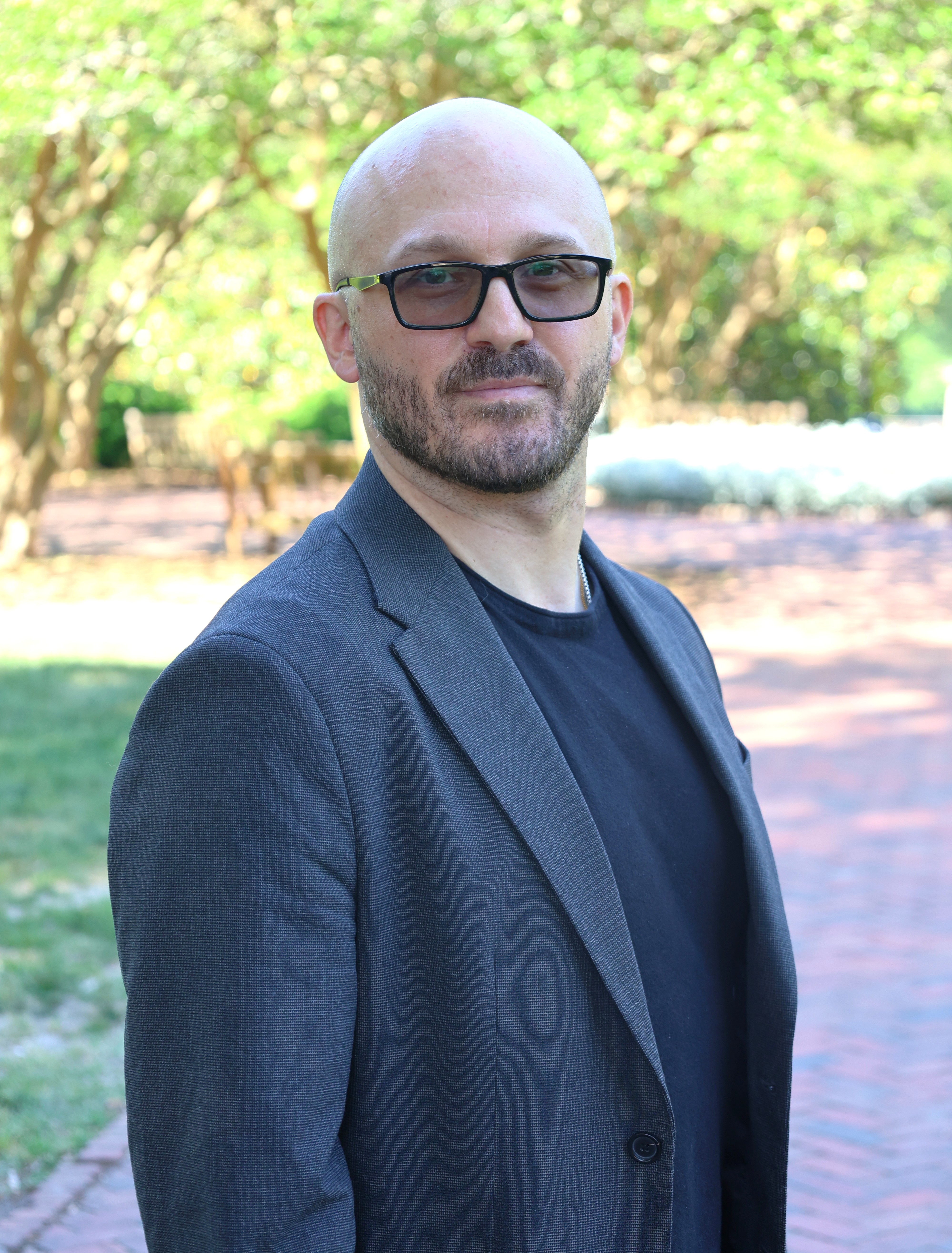 “I am deeply honored to serve as chair of the APS Group on Data Science,” said Fanelli. “AI and data science are rapidly shaping the future of physics research and creating new opportunities for discovery. I am excited to help advance this growing interdisciplinary field and its impact across science.”
At William & Mary, Fanelli leads the DOE-funded AID2E project, which uses AI to improve the design of large-scale detector systems for next-generation physics experiments at the Electron-Ion Collider (EIC), a U.S. Nuclear Physics facility being built at Brookhaven National Laboratory and developed in partnership with Thomas Jefferson National Accelerator Facility (Jefferson Lab) and a broad scientific collaboration.
Fanelli was also awarded a National Science Foundation CAREER Award in 2025 to support his project, “Advancing Nucleon Tomography through Deep Learning and Uncertainty Quantification,” which leverages AI and advanced statistical methods to study the three-dimensional quark and gluon structure of protons and neutrons. The research combines data from Jefferson Lab and other experiments with methods being developed for the future Electron-Ion Collider to improve scientists’ understanding of the strong force and the fundamental structure of visible matter.
Fanelli said the rapid growth of data science and AI is transforming modern physics research, from analyzing massive datasets and accelerating simulations to improving the operation of current facilities and designing next-generation experiments.
Through his APS leadership role, he hopes to strengthen connections between physicists, computer scientists, data scientists and industry partners, while expanding opportunities for students and early-career researchers entering the field.
“We are only beginning to explore the full potential of AI and data science in physics,” said Fanelli. “This is an exciting moment for a rapidly growing community advancing new approaches to scientific discovery.”
The American Physical Society represents more than 50,000 members worldwide and plays a leading role in advancing physics research, education and public engagement.
Editor’s Note: William & Mary is committed to preparing students for data-rich environments and an AI-driven world through thoughtful leadership and human-centered innovation. This vision is taking shape in the new School of Computing, Data Sciences & Physics (CDSP) in collaboration with the entire campus. CDSP integrates AI tools into daily work, including news writing. The CDSP communications team used OpenAI’s ChatGPT to assist in building this article. The team then reviewed and edited the article before publication.