
W&M’s Saskia Mordijck named fellow of the American Physical Society
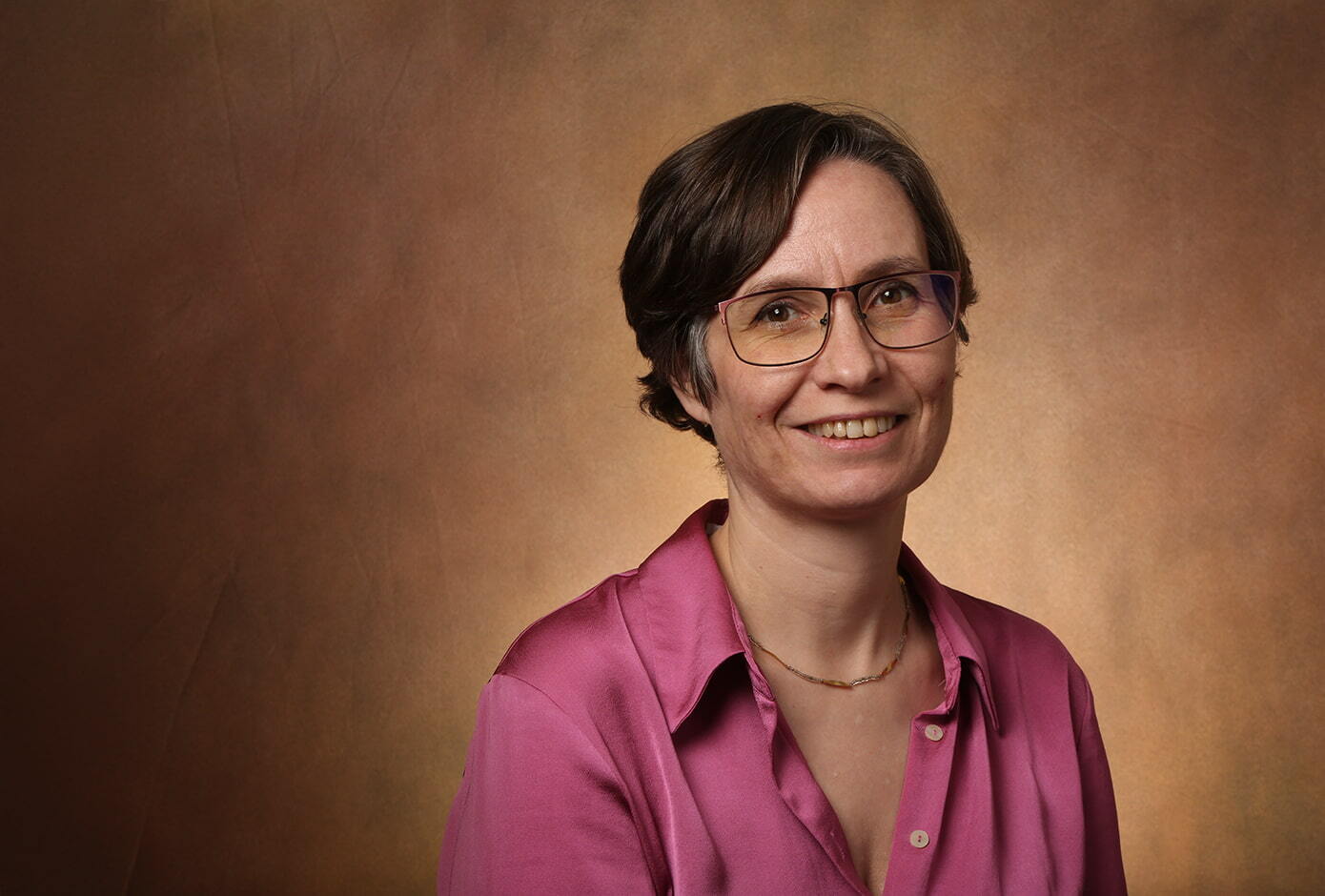 Saskia Mordijck, the Class of 1955 Associate Professor of Physics, has been named a fellow of the American Physical Society (APS).
Founded in 1899, the APS is a non-profit professional organization of approximately 53,000 physicists from academia, industry and national laboratories. Elevation to fellowship is in recognition of exceptional contributions to the field of physics, and no more than 0.5% of members are named fellows of the organization each year.
Mordijck is the eighth current member of the W&M physics department to become an APS Fellow. The others are David Armstrong, Christopher Carone, Irina Novikova, Kostas Orginos, Jianwei Qiu, Patricia Vahle, and Jozef Dudek.
Mordijck’s fellowship highlights the excellence of research and mentorship within the W&M physics department, which will continue to advance with the School of Computing, Data Science & Physics, W&M’s first new school in more than 50 years.
Mordijck was elevated to APS Fellow for her work advancing fusion energy and for her leadership in the plasma research community.
Early Interests
Her interest with fusion began in high school, when a physics lesson on Einstein’s equation E=mc2 led to a discussion about the sun’s power source.
“An off-hand comment from my physics teacher after we first calculated the amount of energy released in fission reactions is that the sun was powered by the opposite reaction – fusion,” said Mordijck. “I never forgot this.”
Years later, as an undergraduate, she learned that one of her favorite professors had worked in fusion research. That was enough: she sought out the opportunity and never looked back.
Building a Star on Earth
Today, Mordijck carries this passion to W&M, where her research focuses on figuring out how to fuel a sun on earth.
Why?
“It is a potentially clean and safe source of energy that could provide baseload power to help cover our growing electricity needs,” stated Mordijck.
Fusion devices are large, highly engineered machines designed to recreate the conditions inside the sun. Inside these devices, gas is heated until it becomes an ultra-hot, electrically charged state of matter called plasma. Powerful magnetic fields are then used to hold this plasma in place so the fuel particles can collide and release energy.
“My research has focused on understanding how the fuel goes from a gas to a plasma and reaches the core of the device to fuel the fusion reactions,” explained Mordijck. “We have developed new experimental and data analysis techniques to study the transport of fuel. In addition, we have worked on developing and validating models to understand the contribution of the gas to the plasma formation at the edge of the fusion device."
Today, her team’s work sits at the frontier of fusion research, where experimental innovation meets computational modeling.
“This means that we have started exploring the utility of AI and Machine Learning techniques to both enhance our ability to extract information from measurements as well as find ways to incorporate these into existing and new theoretical models,” stated Mordijck.
Interdisciplinary Approach
In keeping with the school’s interdisciplinary focus, her research team includes students studying not only physics, but also data science, computer science, and mathematics.
“Fusion requires an interdisciplinary approach, so it makes it an ideal topic to bridge expertise among the different departments within the school,” said Mordijck.
This team has developed models to predict plasma-fuel interactions at the edge of fusion devices, where new fuel is added into the existing plasma within the machine. These interactions at the edge are messy and complicated, but it’s critically important because problems here can shut the whole system down.
Moreover, according to Mordijck, old models work for small machines but don’t scale well for predicting how big, real power plants function— so new models are needed.
In collaboration with W&M’s quantum optics group, Mordijck’s team is using quantum sensors to measure how plasma behaves where it touches the walls of fusion devices—information that is critical for making fusion reactors safer and more efficient, and that also has applications in computer chip manufacturing and in understanding space plasma.
Despite the growing excitement around fusion energy and bold claims that it could reach the power grid within a decade, significant scientific and engineering challenges remain. Overcoming them, Mordijck emphasizes, will require collaboration across many disciplines and career paths, an idea shaped by her own unconventional journey into fusion research.
“My background as a mechanical engineer focused on energy systems wasn't the most logical path to take here in the U.S., but I followed my curiosity,” said Mordijck. “Fusion research does not just require physicists, you need people who build the devices, and you need people who develop code/models to operate devices and analyze data. There are so many opportunities to get involved, and there is no single 'best' path.”
It Takes A Village
While honored to be named an APS Fellow, Mordijck was quick to acknowledge the many amazing people she has had the privilege of working with over the years.
“What makes the recognition even more important is the fact that this doesn't just recognize the research I have been able to do, but more importantly, it does recognize the work I have put in to represent the fusion and plasma community,” Mordijck stated. “Science is done by people and being allowed to help create a community where all can thrive has been a pillar of who I am and how I approach my work.”
Mordijck has served multiple leadership roles within the plasma physics community.
She was the first female leader of the Joint Research Target for the Department of Energy (DOE), served as chair of the expert panel for the Flemish Science Foundation, and is a member of the board for the DOE’s Fusion Milestone Program. She also served as Chair of Women+ in plasma physics, advocating for equitable representation of women in the field, and was President of the University Fusion Association, where she pushed for greater recognition of academic research.
Most recently, Mordijck was appointed to the Virginia Nuclear Energy Consortium Authority Board in December of 2025.
While there are far too many people at W&M to thank individually, Mordijck noted how important they all were in reaching this milestone.
“It takes a village for us all to succeed, and this recognition is for all of them.”