
W&M Racing Team, ‘Flying Fish’ Win Autonomous Boat Competition
W&M Racing Team, ‘Flying Fish’ Win Autonomous Boat Competition
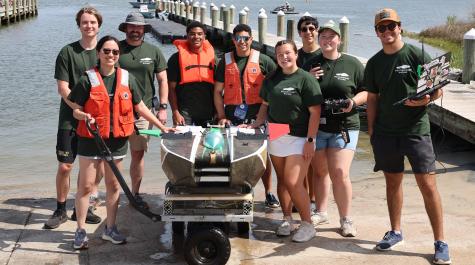
When the winner of the 2026 Promoting Electric Propulsion (PEP) autonomous division was announced, the presenter used one word to describe them: noticeable.
It was clear to everyone watching who had won, finishing the 2-mile course more than five times faster than the second-place team, but beyond the docks, the results turned a number of heads.
William & Mary Racing, competing against large engineer schools like Johns Hopkins, Virginia Tech and North Carolina State, had sailed away from the competition.
A Boat With a Big Idea
The race was part of a national collegiate competition sponsored by the American Society of Naval Engineers and the Office of Naval Research.
Team captain and senior Michael Kelly, an Engineering Physics and Applied Design major, had competed in the race for the past three years. He recalls a conversation with the team’s mentor, Jonathan Frey, when they were designing the boat in the summer of 2024.
“I was working on the boat and going back and forth with Jonathan, and I would say we are kind of like crazy scientists, and it was like, what if we could have a boat that flies?” recalled Kelly. “What if we keep the propellers in the water and we have this flying boat that goes on top of the water, and then we were like, that’s a flying boat.”
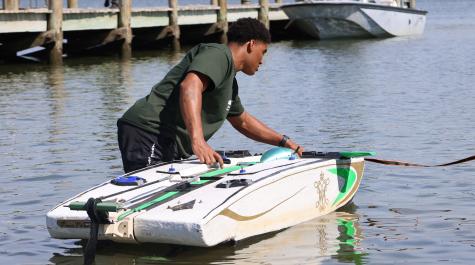
Flying boat became flying fish. The idea stuck, and in a nod to Italian designers and engineers, they named the boat Pesce Volante.
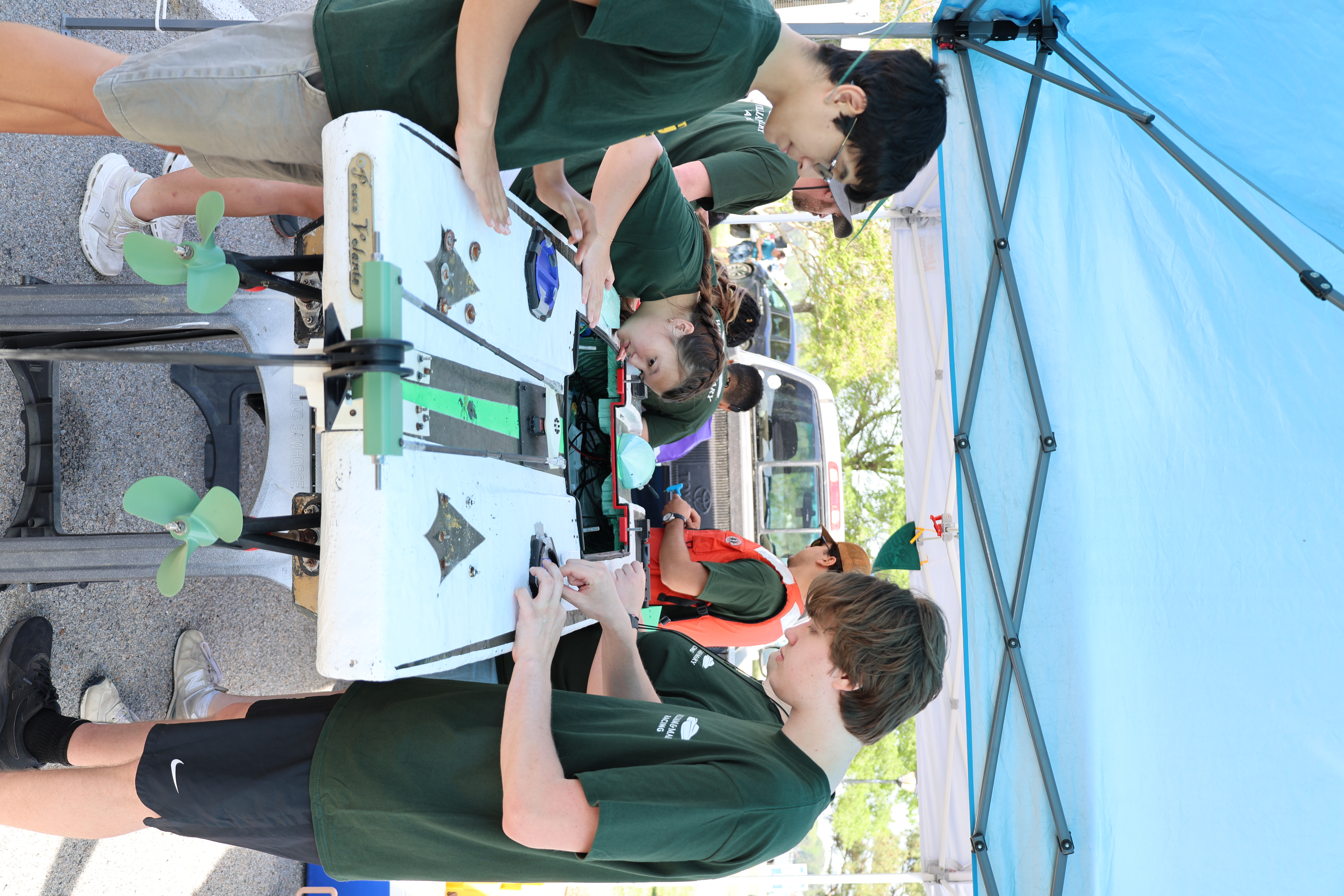
The idea of a flying boat drove their design process. With a custom-built hull and experimental features like active aerodynamics, Pesce Volante stood out among the competition.
“We had this question of where did you guys buy your hull, and we’re like, we made it,” said Kelly. “They are like, no where did you buy it, and we’re like…we made it.”
Curiosity only grew after the race. Senior Ben Monforth, another EPAD major, said competitors from larger programs regularly stopped by to ask about the boat’s design.
“They are coming and talking to us and asking about our boat, which was built on a tight budget compared to pretty much everyone else,” said Monforth. “It was just a good feeling because a lot of this is just raw effort and determination.”
The attention reflected the time spent on the project. After hundreds of hours designing and building, Kelly said that commitment is what ultimately set them apart.
“I feel we put in the effort. [Another team] told us, I see you have active aero – we were going do that but it was too hard, and we're like, yeah, it's hard.”
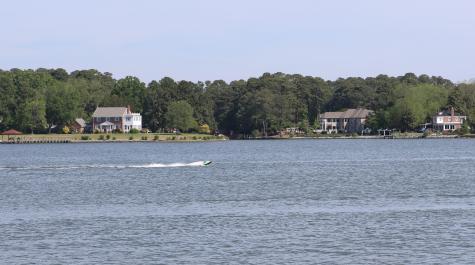
While the competition featured six divisions, both manned and unmanned, this marked the debut of the autonomous category. Teams programmed GPS waypoints and then handed off control entirely, allowing the boats to navigate the two-mile course on their own.
 Making the boat autonomous proved to be a challenge.
“The trick with autonomy is there are so many parameters in the firmware that you have to meddle around with that affect other aspects of the boat,” explained Monforth. “When you have hundreds of thousands of parameters that are not easy to change, and you don't have a library of what each parameter does, it makes it very difficult.”
It wasn’t exactly smooth sailing. The team spent months running tests at Lake Matoaka, tweaking everything from GPS drift to safety shutoffs. A couple of weeks before the competition, the team was still racing to figure out the autonomy.
“We kind of hit a plateau and were super stressed because we didn’t know if we could re-enter the manual race,” explained Monforth. “We reached an inflection point, is this going be a manual boat or are we going to go all in with autonomy, and thankfully we did because we won, but we learned a lot as well.”
Hub For Innovation
One factor that helped lead to the team’s success was the university’s new Makerspace located in ISC4.
While the team appreciated the tools and new work area, it was the Makerspace’s open design that put the boat on display and increased their visibility on campus, piquing student curiosity and bringing in new talent.
"The amount of people now that are able to come and see the Makerspace, it's really cool because they are walking through and asking questions,” stated senior team member Isaiah Lemmond. “They would ask us what we were doing, they didn’t know William & Mary had things like this.”
While the team has traditionally been made up largely of EPAD students, Lemmond said the increased visibility is drawing interest from across campus, to include students outside of STEM, such as those in the business school.
He believes it’s the hands-on nature of the work that pulls people in.
“We're learning things that you wouldn't learn in class, like how to work with tools, how to lay carbon fiber. It's stuff that you would learn in the industry that you're getting now,” said Lemmond. “It's really cool to see the excitement on their faces when they come in and actually learn how to do things.”
The hands-on experience is how Kelly pitches the team to interested students.
“We’re a small team, so we are going to make you do things. You're going to get as much as you put into it.”
Flying Fish’s Future
While several members of the William & Mary Racing team will graduate this month, Pesce Volante is far from slowing down. A growing group of underclassmen and the promise of new recruits are ready to take the helm.
The team is already exploring ways to refine the boat’s performance and build out more advanced autonomous capabilities, including an AI-driven system that brings in expertise from computer science and data science students.
With a first-place trophy in hand, renewed momentum, and a highly visible home in the Makerspace, TribeRacing is looking ahead. If the name Pesce Volante is any indication, the “Flying Fish” isn’t done yet, it’s just getting ready to rise even higher above the water.
The William & Mary Racing team is comprised of Michael Kelly Galdamez, Isaiah Lemmond, Ben Monforth, Keyra Ogura, Megan Blake, Eliot Hettler, Lauren Ho, Kayla Charway, and Scott Morefield. They are mentored by Professor Jonathan Frey, who also serves as the Makerspace Director.