
William & Mary professor wins NSF CAREER award to develop new AI methods for dynamic graphs
 Most artificial intelligence systems learn from data as though the world stays relatively stable. In reality, many systems constantly evolve and are interconnected with other systems that are also changing over time. These networks can be represented as dynamic graphs that have individual components that change over time, as do the relationships and interactions that connect them.
Think financial markets, social media networks, weather forecasting or a power grid. Understanding not only what is changing, but also how those connections are changing, presents a significant challenge for AI systems.
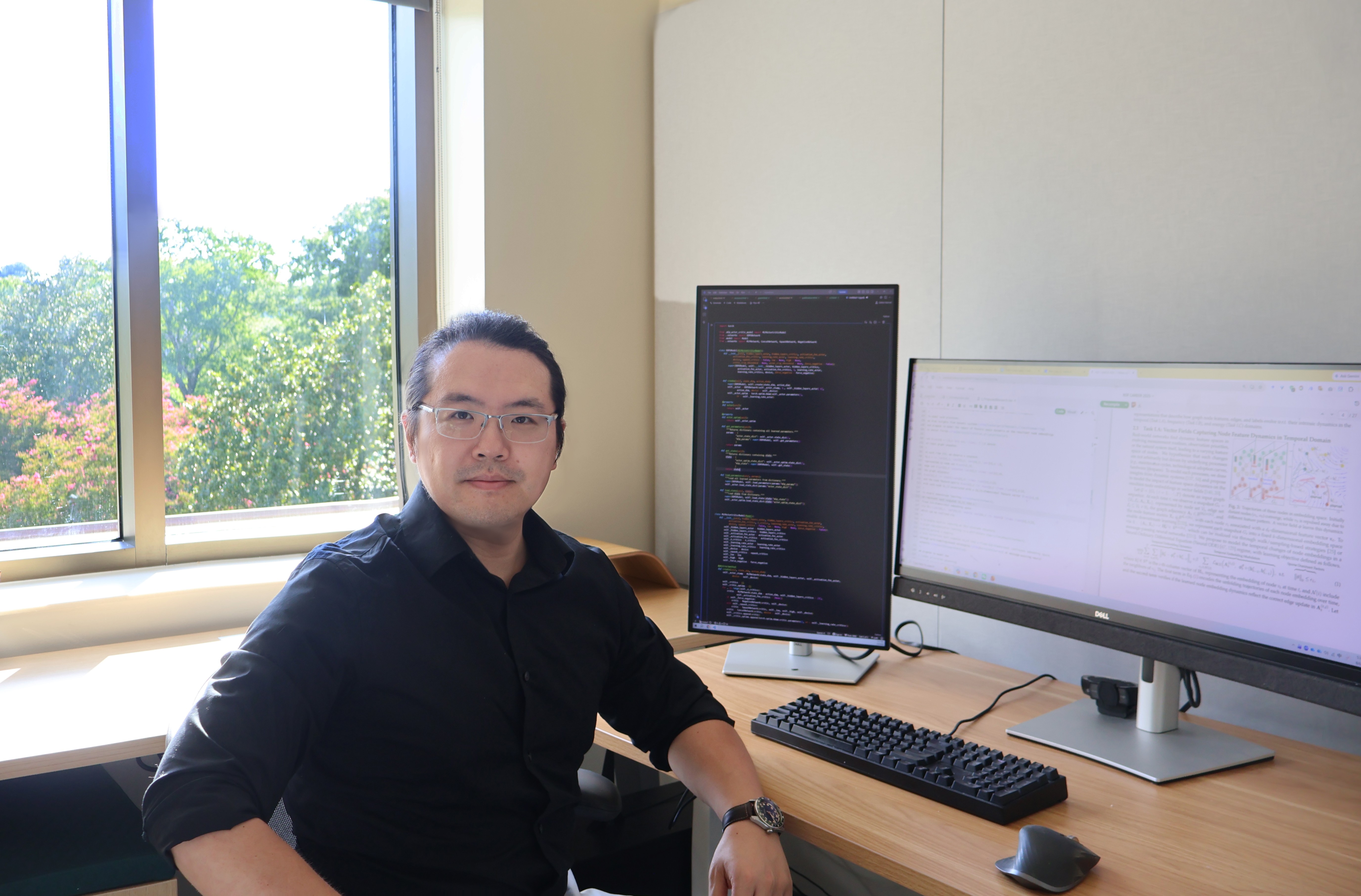
Dr. Yi He, assistant professor of data science, was recently awarded a prestigious National Science Foundation CAREER award to develop AI methods that can learn from these evolving graphs.
The award provides close to $500,000 in grant funding over five years to support his project, Harnessing Graph Dynamics for Learning in Changing Environments.
Graph machine learning represents the components of a connected system as nodes and the relationships among them as links. In coastal-ocean monitoring, for example, nodes may represent monitoring stations that measure water temperature, salinity, dissolved oxygen, currents, and other environmental conditions. Measurements at different locations cannot be analyzed independently because water movement and other physical processes connect conditions across the broader system.
Many existing graph-learning models identify recurring patterns in historical data while assuming the relationships within the graph remain relatively stable. This assumption can become unreliable when a storm, tidal shift, seasonal transition, or other events alter how different parts of the system interact. Under such conditions, a model may continue applying relationships learned from the past even after the system has entered a substantially different operating regime.
“Imagine two monitoring locations whose measurements have historically changed together,” He said. “After a storm or a shift in currents, that relationship may weaken, strengthen, or even change direction. A model that treats the historical network as fixed may continue relying on the old pattern, even though the physical system is now behaving differently.”
He’s project will study graph dynamics from three perspectives.
Temporal analysis will characterize how the states of individual nodes evolve; spectral analysis will examine how connectivity patterns emerge or disappear across the network; and an energy-based perspective will help identify transitions into new and previously unseen system regimes. These components will allow the models to examine what is changing and how changes propagate through an interconnected system.
The project will then integrate these learned dynamics with known physical principles and system invariants. Constrained optimization will help align predictions with principles such as conservation laws, Bayesian inference will account for uncertainty in initial conditions, and real-time stability monitoring will identify predictions that may depart from safe or physically plausible system behavior.
“Data tells the model what is happening, while physics helps define what is possible,” He said. “Our goal is to preserve the flexibility of machine learning while ensuring that the model produces predictions that are reliable, physically consistent and stable.”
More reliable predictions could support earlier, more trustworthy warnings when environmental systems undergo significant changes. In coastal settings, for example, this could help scientists, resource managers, and aquaculture stakeholders recognize emerging risks sooner, prioritize monitoring efforts, and make better-informed decisions.
Since the underlying framework is designed to apply broadly to complex, evolving systems, the methods could also improve prediction and decision-making in areas such as industrial systems, power grids, and other critical infrastructure in which relationships and operating conditions change over time.
He intends to incorporate his research into courses on graph learning and the computational foundations of data science, in addition to having graduate and undergraduate students help in the development and evaluation of the new methods.
“If successful, this project could help AI systems remain reliable even when the environments they operate in are changing rapidly,” He said. “By combining learned patterns with physical principles, we hope to provide earlier and more trustworthy signals of emerging risks, giving scientists and decision-makers more time and confidence to respond. At the same time, we hope to prepare the next generation of researchers and practitioners to understand when AI predictions can be trusted and why physical knowledge matters when these systems are used in the real world.”