
William & Mary Professor Wins Dual Research Awards from Google and Amazon Web Services
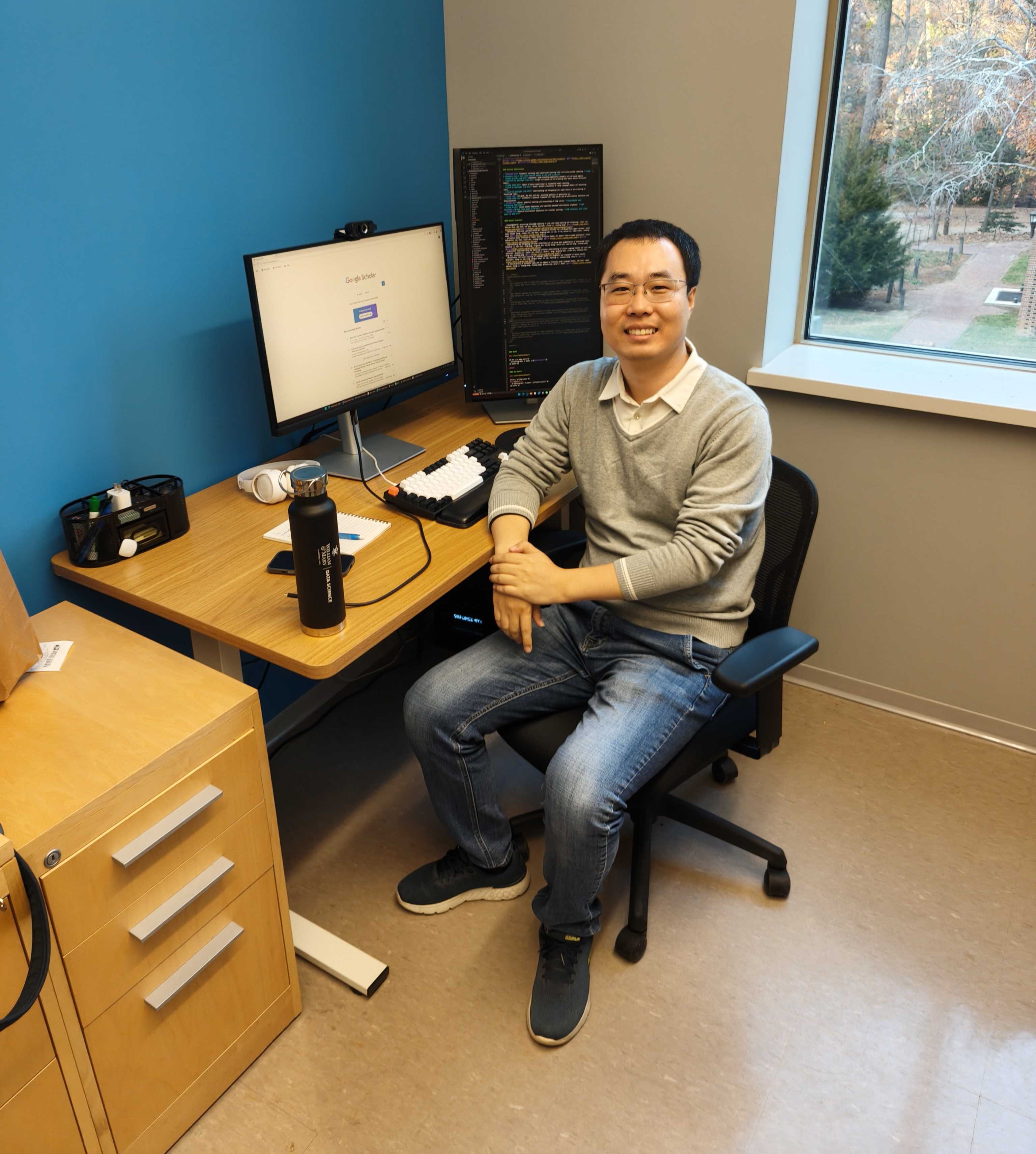 William & Mary Assistant Professor of Data Science Jindong Wang has received two competitive research awards from Amazon Web Services (AWS) and Google, recognizing his groundbreaking work in advancing the structure, safety, and reliability of artificial intelligence systems.
Wang was selected for the AWS Agentic AI Amazon Research Award (ARA) for his proposal, “Structure Matters: Task-Optimized Topologies for LLM Agents,” and received a Google Research Gift for his project, “Robust Foundation Models: Understanding and Mitigating the Impact of Imperfect Pre-training Data.”
Exploring How AI Agents Collaborate
Through the AWS award, Wang will receive $70,000 in unrestricted funding and $30,000 in AWS credits to pursue his vision of designing AI systems that can collaborate more efficiently.
“This project aims to rethink how AI agents work together,” Wang said. “By learning the best structures for collaboration, we can build systems that are not only more powerful, but also more efficient, robust, and transparent.”
The project aims to build next-generation AI systems that can collaborate, reason, and adapt far more effectively than today’s models. By understanding how multiple AI agents interact and make decisions together, this research opens the door to powerful applications – from safer autonomous coding tools and more reliable strategic planning systems to AI assistants that can help accelerate scientific discovery.
Ultimately, Wang’s work contributes to creating AI systems that are not only more capable, but also more trustworthy and aligned with human goals.
AWS Agentic AI aims to advance agentic AI research by funding development of open-source tools and research that benefit the AI community at large, or impactful research related to agents.
Building Fairer, More Reliable AI Models
Wang’s second project, supported by a $30,000 unrestricted gift from Google, focuses on improving the robustness and fairness of large foundation models such as LLMs and vision-language models. His work explores how these models inherit bias and noise from their massive, imperfect training data, and develops methods to correct these issues without having access to proprietary datasets.
“This research aims to make AI more responsible and dependable by addressing flaws introduced during pre-training,” Wang explained. “It’s a step toward making foundation models safer and more inclusive in real-world applications.”
The unrestricted gift from Google supports groundbreaking foundational and applied research in computing and technology.
About William & Mary’s Data Science Program
Dr. Wang’s work advances the Department of Data Science’s research cluster on agentic augmentation and interaction, developing new ways for large language models to interact with humans and with each other to transform how these systems are used.
Building on this innovative research environment, William & Mary’s Data Science programs prepare students for careers that apply AI and big data methods to turn information into insight. The Department offers tracks for double majors, focused on how and when to use AI, and for primary majors - focused on building new tools through programming and machine learning. It also has Ph.D. and forthcoming MS learning opportunities. Learn more at https://www.wm.edu/as/data-science/.
Editor’s Note: William & Mary is committed to preparing students for data-rich environments and an AI-driven world through thoughtful leadership and human-centered innovation. This vision is taking shape in the new School of Computing, Data Sciences & Physics (CDSP) in collaboration with the entire campus. CDSP integrates AI tools into daily work, including news writing. The CDSP communications team used OpenAI’s ChatGPT to assist in building this article. The team then reviewed and edited the article before publication.