
TribeCyber Earns Third Place in Virginia Cyber Cup Debut
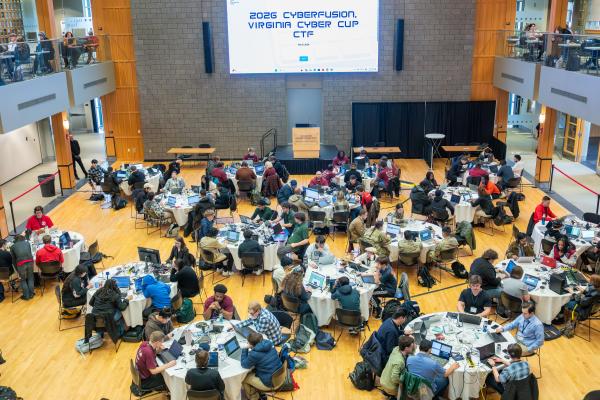 William & Mary’s TribeCyber team made their presence known in their debut at the Virginia Cyber Cup Competition, earning a third-place finish against competitors from across the Commonwealth.
Held as part of Cyber Fusion 2026 from Feb. 21-22 at the Virginia Military Institute, the invitation-only competition brought together 27 Virginia colleges that have been designated as a National Center of Academic Excellence in Cyber Defense by the National Security Agency and the Department of Homeland Security.
The half-day capture-the-flag event challenged students to apply both technical knowledge and real-world problem-solving skills. Unlike online competitions such as the National Cyber League, the Virginia Cyber Cup emphasized hands-on challenges, including hardware-based tasks that required participants to work with physical equipment such as antennas and radio signals.
The format added a layer of realism, and difficulty, that pushed teams beyond traditional cybersecurity exercises.
“It was definitely higher stakes, higher pressure, with only a couple hours to do it in,” said Matthew Esposito, a senior majoring in computer science and philosophy. “The fact that this competition was physical for a lot of the challenges made it very interesting. It felt a lot more realistic in terms of what you would be doing in a job that required those tasks.”
While TribeCyber posted the highest scores in traditional challenges, they lacked prior exposure to the physical events and did not have the right specialized equipment.
“There were hardware challenges that we weren't necessarily prepared for,” said Camden Good, the team captain and senior computer science major. “This is our first year competing at this one, whereas other teams have been competing for years. Next year, if we can pull together a team that can do as well in traditional challenges and be prepared for the hardware challenges, we should win.”
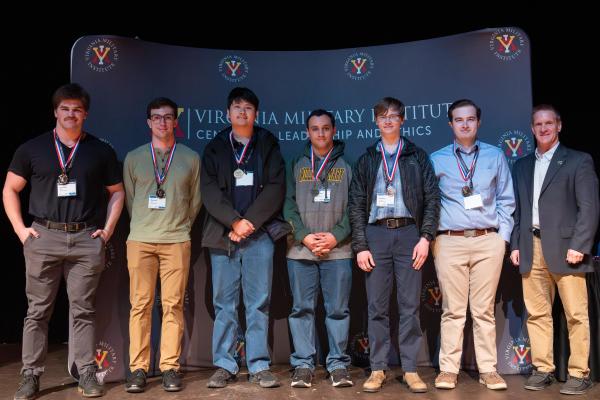 Dr. Matthew Chapman, a teaching professor in the Department of Computer Science and the coach for TribeCyber, said the team made their presence known in their first year of the competition while also getting a chance to network with their peers.
“Our team stepped into the ninth year of this event and quickly put the rest of the schools on notice by challenging the top position all day,” stated Chapman. “I am incredibly proud of the technical abilities and teamwork they demonstrated as newcomers to this event. It was a really fun weekend and a chance for us to meet many of Virginia’s finest cyber students and faculty.”
The team that competed in the Virginia Cyber Cup included Good, Esposito, Nicolas Janis, Josh Pomeroy, Zach Bowden, and Carson Gada.
Their performance reflects the rapid growth of William & Mary’s cybersecurity program. Several members of the team also helped secure a second-place finish in the Spring 2025 National Cyber League team competition.
Both Esposito and Good were quick to credit Chapman building enthusiasm for the field.
“In the few years that I’ve been here we went from occasionally placing top 100 in NCL to finishing second and third,” Esposito said. “It's been a wild ride, and I think that's almost completely Chapman's doing.”
“He's really good at getting people excited about [cybersecurity],” added Good. “Not only does he teach theory, but it's very practical. You feel as though after taking this class, you know how things work and what to do once you get sat in a chair in front of a keyboard and you're asked to do a task.”
As AI advances and our world becomes more digitally interconnected, the need for strong cybersecurity practices continues to grow. This rising importance extends beyond specialists in the field, which is why Good encourages students across all majors to at least build a foundational understanding of cybersecurity, whether it is by pursuing a minor in cybersecurity or just taking a class.
“It's a growing field. Students who don’t necessarily want to be cybersecurity professionals or just who just want to write back-end code need to understand these principles.”
Editor’s Note: William & Mary is committed to preparing students for data-rich environments and an AI-driven world through thoughtful leadership and human-centered innovation. This vision is taking shape in the new School of Computing, Data Sciences & Physics (CDSP) in collaboration with the entire campus. CDSP integrates AI tools into daily work, including news writing. The CDSP communications team used OpenAI’s ChatGPT to assist in building this article. The team then reviewed and edited the article before publication