
Students Earn Top Honors in Virginia Microelectronics Research Program
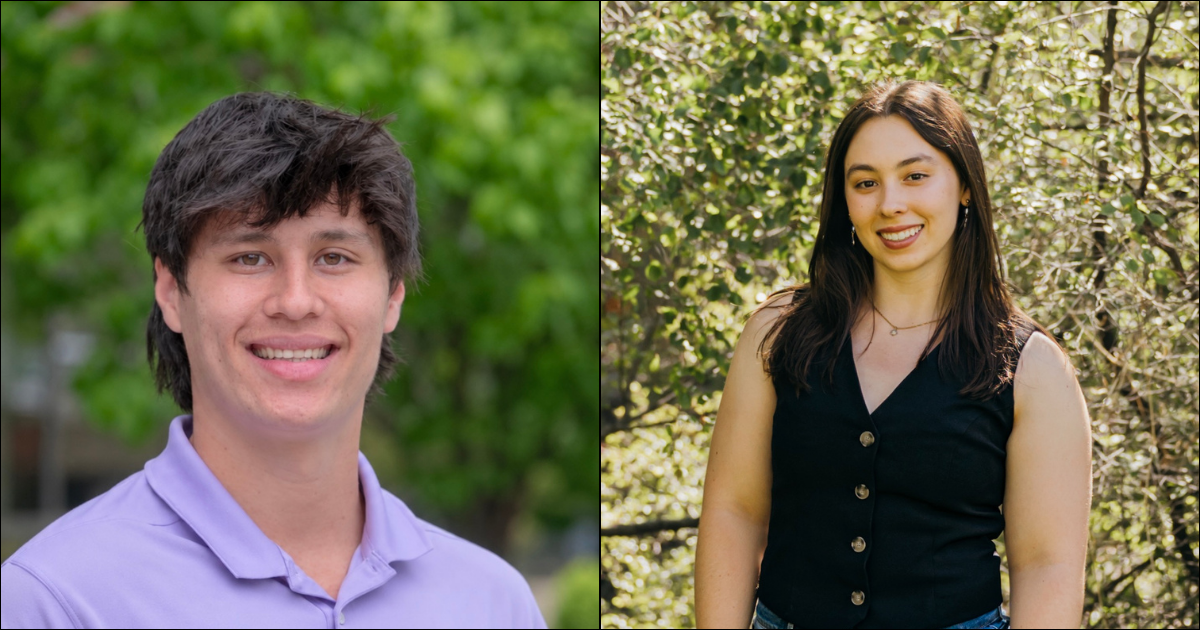 Two William & Mary students from the School of Computing, Data Sciences, & Physics earned Gold Awards by the Virginia Microelectronics Consortium’s (VMEC) Summer Scholarships program, placing their research among the top presentations in the statewide program.
VMEC partners with universities and industries across Virginia to provide undergraduate students hands-on experience in microelectronics through a 13-week research internship at an academic or industrial laboratory.
At the end of their internships, each scholar presents their research findings to the VMEC Executive and Operations Committee. The top four presentations receive Gold Awards, which comes with a $250 prize and a digital badge recognizing the achievement. Both W&M students earned Gold Awards this summer, a notable accomplishment considering W&M had just two students in the program’s 26-member cohort.
Meet the Scholars
 Richie De Luna, a senior studying Physics on an Engineering Physics track, spent the summer at Virginia Commonwealth University (VCU) researching different methods to build infrared detectors. His project expanded on previous research by combining the polar and non-polarizing structures of zinc oxide within the same device to see whether infrared detectors could operate without being cooled. This, De Luna said, “can make the devices cheaper as it does not have to be cooled”.
De Luna said he did not know much about infrared detector technology prior to this experience. Over the course of the summer, he gained hands-on research experience while learning from graduate students in the lab, but beyond the technical skills he developed, he considers the program's presentation component one of his greatest accomplishments.
“Public speaking does not come naturally to me,” De Luna stated, “I learned a lot about how to present science [to an audience that may not be familiar with the subject being presented].”
Winning the Gold Award was “a validation in my public speaking,” he said, adding that he had put a lot of effort into preparing for his presentation.
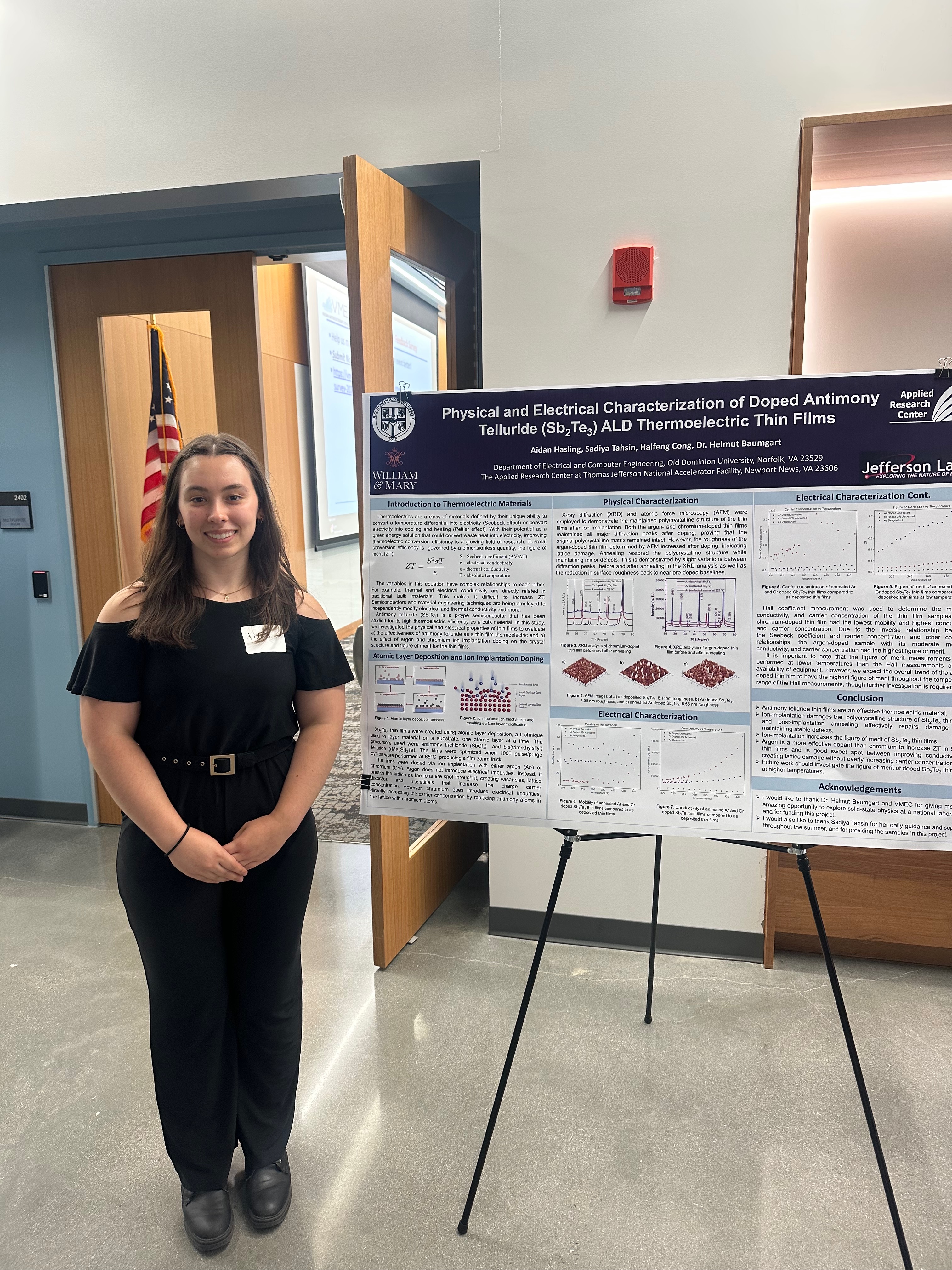 Aidan Hasling is a senior double majoring in Physics and Biology and interned this summer at Old Dominion University and the U.S. Department of Energy’s Jefferson Lab. Her project focused on the different characteristics in antimony telluride, a thermoelectric semiconductor, to see how to improve its efficiency in converting heat into electricity. By studying the material as a thin film, she explored ways to lower its thermal conductivity while increasing its electrical conductivity, a balance that would help the material convert heat into electricity more efficiently.
“Semi conductors are our entire world, they are incredibly important,” Hasling said. “I was looking at something that is a little more niche within the semiconductor industry…thermal electrics are not widely applied…but it has potential to be a good sustainable solution for our energy crisis.”
The experience also gave her a greater appreciation for the precision required to manufacture semiconductors. “It’s ridiculous how precise the industry has to be to make our entire world function,” she said. Winning the Gold Award, she added, reaffirmed her confidence in presenting scientific research and in simplifying a complex topic.
Both De Luna and Hasling explained that the win felt personal with learning that both William & Mary participants received Gold Awards this year. De Luna said he felt “straight pride”, while Hasling said it “makes you proud to be at W&M”. She also added that “we have gotten a lot of great skills from the work we have done in the Physics Department”.
For both Hasling and De Luna, the recognition was especially meaningful because William & Mary's two participants each earned Gold Awards. De Luna said he felt “straight pride,” while Hasling said it “makes you proud to be at W&M.” She also credited her academic preparation, adding that “we have gotten a lot of great skills from the work we have done in the Physics Department.”