
Secure AI meets the ocean: Student fellows help chart the future of marine science
Most people are used to scrolling effortlessly through hundreds if not thousands of images every day on social media, streaming platforms, and targeted advertisements. But imagine having to sift through millions of blurry underwater photographs, one by one, manually counting and measuring every scallop on the ocean floor.
For decades this painstaking work had fallen squarely on marine researchers, who spent countless hours sorting and labeling seafloor imagery to estimate species populations. It was a process that was slow, expensive, and increasingly unable to keep pace with the tidal wave of data modern ocean science now produces.
The rise of machine learning and artificial intelligence is helping marine scientists make sense of all this data, and at a speed that would have previously required an army of researchers. But as AI systems become increasingly important to environmental monitoring and fisheries management, researchers must also understand how to make those systems reliable, trustworthy, and secure.
That was the focus for this spring’s Oceanic AI Fellowship, supported by the Experiential Learning Program of the Commonwealth Cyber Initiative. This fellowship brings together institutions of higher education across Virginia to build critical cyber and AI skills through hands-on, real-world experiences.
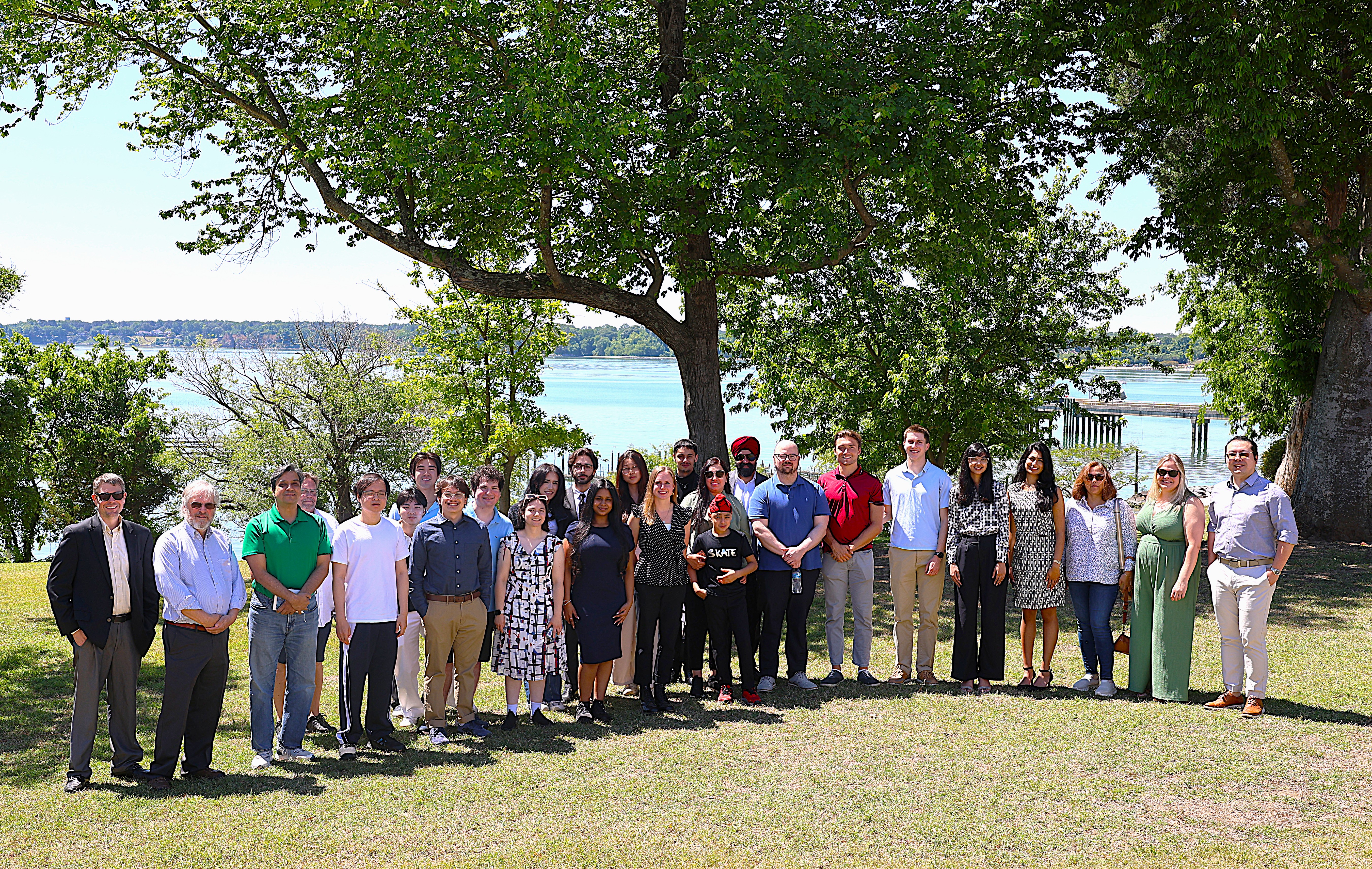
The fellowship attracted widespread interest across the state, drawing nearly 200 undergraduate applications. Ultimately, 26 students completed the program, representing William & Mary, Christopher Newport University, George Mason University, Old Dominion University, and Virginia Tech.
Though most of the fellows were computer science and data science majors, the inclusion of students majoring in government, economics, and human health underscored the program's broader workforce-development mission: preparing students from multiple disciplines to understand how secure and trustworthy AI can support high-impact domains such as marine science, public policy, and environmental decision-making.
At a May 10 recognition ceremony on the Batten School & VIMS campus, Dr. Yi He, assistant professor of data science at William & Mary and the fellowship director, emphasized that the program was designed to do more than teach technical skills, it was meant to help students envision new career pathways in at the intersection of secure AI, cybersecurity, data science, and environmental applications.
“Our goal is to prepare you with the real-world skills that launch careers at the intersection with AI, cyber skills, and ocean science,” He told the fellows. “You are exposed to this experience so that in the future, when you're trying to decide your career, you know these opportunities and these demands do exist.”
Dr. Roger Mann, a professor at William & Mary’s Batten School of Coastal & Marine Sciences & VIMS, has spent five decades watching marine science evolve into an era defined by massive streams of digital ocean data. Seeing students apply AI to real marine science challenges gave him confidence that the next generation of researchers is prepared to transform the field in ways previous generations could scarcely imagine.
“I don't think you realize that you're standing on the edge of an enormous leap, which many of us in marine science have been struggling with for a long period of time,” said Mann. “You're at the point where you literally stand at the other end of a giant fiber optic cable with more data than we could ever have dreamed about, and your challenge is how you turn that into intelligible science, policy, and guidelines.”
Applied Learning in Secure Marine AI
The fellowship organized students into two separate technical tracks.
Fellows in the computer vision track trained AI models to analyze underwater seafloor imagery, including species detection tasks where corrupted or misleading data could affect model outputs. Fellows in the graph neural network track studied sparse ocean survey data and image-graph fusion methods to estimate species distributions and examine how AI pipelines can remain reliable under noisy, incomplete, or potentially manipulated data.
Austin Rice ’26, a data science major, said what drew him to the fellowship was the opportunity to work on research that contributes to a broader understanding of natural resources.
“I was motivated by the opportunity to apply the technical skills I’ve developed in data science to a real-world problem with meaningful environmental impact,” Rice said. “Unlike most classroom assignments, this project involved messy real-world data, open-ended experimentation, and the challenge of producing results that could have practical scientific value.”
Beyond the technical training, organizers emphasized the broader societal significance of secure and trustworthy AI. Better ocean data and reliable analysis can directly influence fisheries management, climate research, transportation systems, environmental protection, and international policy. When these decisions depend on AI systems, students must understand not only how to build models, but also how to evaluate their robustness, limitations, and security risks.
As a human health & physiology major, Zahra Rizvi ’28 wasn’t the typical fellow, but it was the applied learning and potential impact that drove her to the fellowship.
“I wanted to explore cross-disciplinary work where data science can solve practical problems,” stated Rizvi. “Since I was born and raised in coastal Virginia, the Chesapeake Bay and our coastal environment are very close to my heart, so this fellowship felt like a meaningful way to connect AI with service to the Virginia Commonwealth.”
Editor’s Note: William & Mary is committed to preparing students for data-rich environments and an AI-driven world through thoughtful leadership and human-centered innovation. This vision is taking shape in the new School of Computing, Data Sciences & Physics (CDSP) in collaboration with the entire campus. CDSP integrates AI tools into daily work, including news writing. The CDSP communications team used Google’s Gemini to assist in building this article. The team then reviewed and edited the article before publication.