
AI meets healthcare to address critical challenges
Approximately one million people in the United States suffer from Parkinson’s disease, a neurodegenerative disorder characterized primarily by motor symptoms such as tremors, rigidity, slowed movement, and postural instability.
Freezing of gait is a common and debilitating symptom of Parkinson’s disease. During these episodes, patients suddenly feel as if their feet are “glued” to the ground while their upper body continues to lean forward. These events can lead to falls and a significant loss of independence.
While some of the most commonly used therapies for Parkinson’s includes restoration of dopamine signaling in the brain, deep brain stimulation, and physical therapy, William & Mary professor of Computer Science Gang Zhou is exploring another approach: wearable AI technology.
Zhou’s team — which includes Ph.D. students Kenneth Koltermann and Johnny Clapham as well as collaborators at VCU Health — has developed two technologies to address this challenge: Gait-Guard and Trigger-Finder.
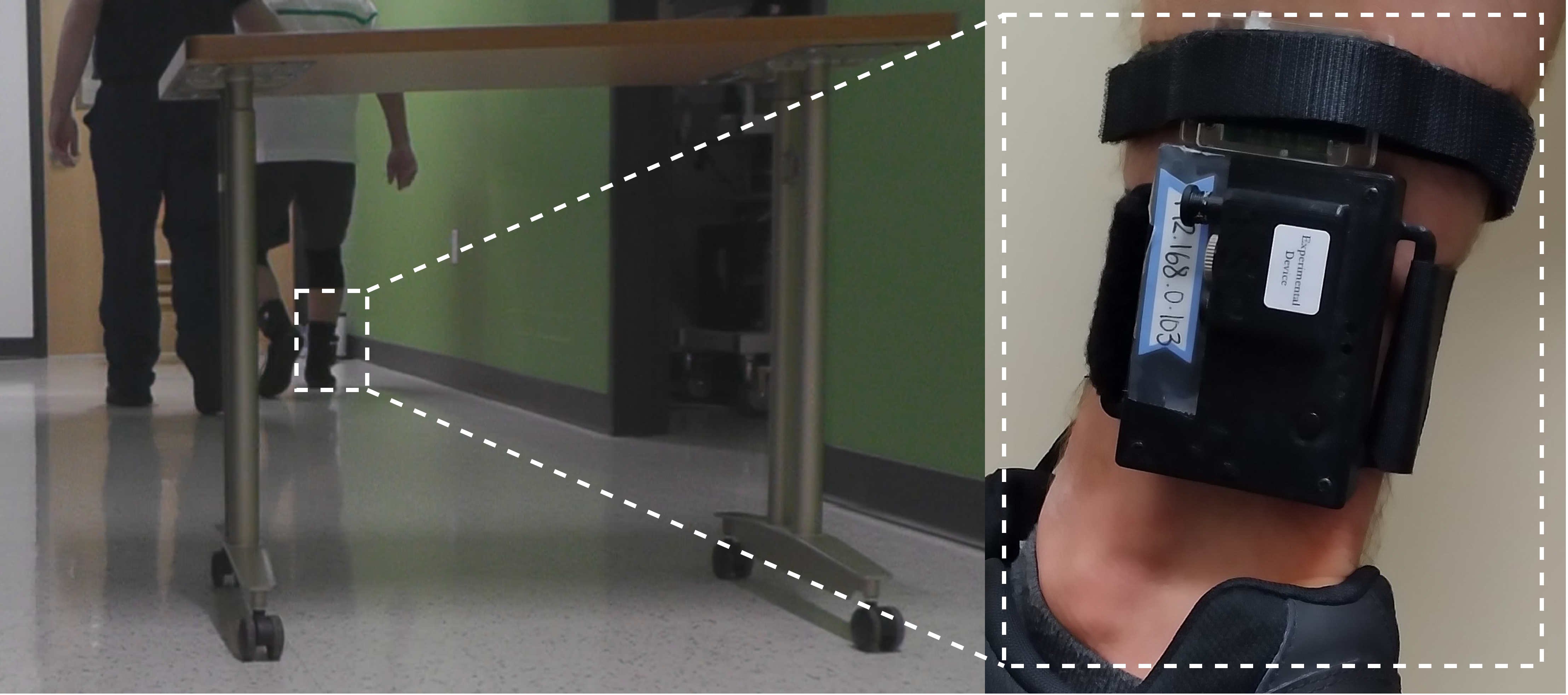 Gait-Guard is a sensor worn on the ankle that detects abnormal gait patterns in real time and delivers gentle vibration cues that help patients regain movement and continue walking safely.
“The clinical specialists at VCU explain that the vibrational cues from the ankle cuff activate parts of the brain that aren’t impacted by Parkinson’s disease, and this vibrational stimulus is enough to help patients resume walking,” Zhou says.
The team has also developed Trigger-Finder, a chest-worn device that tracks a patient’s surroundings, similar to smart glasses. Using advanced AI models, the system analyzes environmental patterns, such as tight turns or narrow spaces, to identify potential triggers for freezing episodes.
Zhou’s group aims to combine data from Gait-Guard with environmental data from Trigger-Finder to predict which situations may trigger freezing of gait. The system could then alert patients to potential risks and help prevent freezing episodes before they occur.
Together, this approach represents a shift from reactive monitoring to proactive prevention.
These technologies have been tested with more than 30 Parkinson’s disease patients, have been patented, and are now being commercialized through a Virginia-based startup company.
AI4Health at William & Mary
Zhou’s work on Gait-Guard and Trigger-Finder is part of William & Mary’s AI4Health, a provost-funded initiative that brings faculty from computing, health sciences, and other related fields together to address real-world healthcare challenges.
 Zhou, who leads the AI4Health initiative, said they provide funding for interdisciplinary courses and research projects that integrate AI and healthcare.
Some recent examples include courses and research exploring how AI can be applied in counseling education. Students in counseling and computer science examine ethical questions surrounding AI in mental healthcare, discussing potential risks, safeguards and professional responsibilities.
Another project had computer science researchers develop large language model-based patient simulations that undergraduate counseling students interacted with during training. The system analyzes the counseling students’ responses and provides feedback, which they then compare with their own assessments and instructor guidance.
AI4Health also provides funding to support the commercialization of projects that apply AI to practical healthcare solutions. One recent example is the research and commercialization support for iRays, a portable AI-powered device designed to quickly measure pupil responses, with the potential to improve neurological assessments for conditions such as traumatic brain injury.
While there is vast potential for AI to transform the healthcare industry, Zhou is quick to emphasize that artificial intelligence should enhance — not replace — clinical expertise.
“AI in healthcare is not about replacing clinicians — it’s about empowering them,” said Zhou. “At William & Mary, we’re building the technologies, partnerships and talent needed to extend care beyond hospital walls and make healthcare more proactive and accessible.”
Leadership in AI and Healthcare
Zhou is a recognized leader in AI for health, with his research earning Best Paper Awards for two consecutive years at the ACM/IEEE Conference on Connected Health. He is a Fellow of the Institute of Electrical and Electronics Engineers, an elected member of the National Academy of Artificial Intelligence, and serves as Editor-in-Chief of ACM Transactions on Computing for Healthcare, a leading journal at the intersection of computing and health sciences.
Zhou notes that as the university builds momentum in applying AI to critical healthcare challenges, students are playing an increasingly central role in driving that progress.
“William & Mary students are highly motivated, intellectually curious, and eager to make a meaningful impact,” Zhou says. “Mentoring students who succeed professionally and contribute meaningfully to society is one of the most fulfilling aspects of my work.”